

Humanity
"If there's one thing you can say about Mankind, there's nothing kind about man." - Tom Waits

Humanity
There are some important things you really need to understand about humanity that aren’t taught in school, nor are they commonly the subject of conversation. What our tomorrow looks like, or even whether we’ll have a tomorrow, may depend on it.
You may have heard of the “Fermi Paradox.” to oversimplify for brevity’s sake, the Fermi Paradox asks why, given the likelihood of their being billions of planets in our galaxy, we aren’t hearing anybody chattering among themselves, or sending us “Hello World” messages. When we listen, all that we hear is the distant echo of the explosion that began it all, 13,500,000,000 years ago.
There are a lot of proposed solutions for the Fermi Paradox, but one of the most likely seeming, at least to us, is that intelligent, tool-using civilizations tend to get to a certain point – probably the point where they are capable of autoclaving their own planet with nukes or excess carbon dioxide – and then die off. Apparently, this window of self-destruction, where technological know-how has outpaced the development of cultural wisdom, is common enough that no nearby civilization has survived it.
Technological advancement is geometric – it builds on itself at an increasing rate. Advancement in wisdom and understanding is incremental and arithmetic – dependent on encounters and discussions with others, dissemination of knowledge and understanding throughout the culture and the sifting of that knowledge through examination and discussion. Wisdom will always lag behind technological change. We will always have new devices and methods before we understand how to best use them, or before we fully understand the hidden costs and dangers they might bring with them.
In order to avoid being strained out of existence by the “Fermi Filter,” we need insight into this process, and how to overcome it. We need to understand who we are as a species, and what has made us successful thus far. And we need to use the strengths we have to consciously overcome our obvious weaknesses. Now, let’s take a species-wide view of humanity, and begin to answer those questions.
From an evolutionary point of view, what makes humans unique? Not intelligence – there is quite a bit of evidence that other species have intelligence, and even self-awareness. Not language – again, recent research seems to indicate that a number of species are capable of communicating emotion and experiences to each other.
We aren’t the strongest, or the fastest. But we are very successful indeed. No other species lives in such a wide variety of climates, from the equator to the Arctic and Antarctic. No other species travels everywhere on the planet – and off it – at will. So why have we been so successful, and why has that success put us in such danger?
Consider the wolf. Let’s say you take a wolf, and drop him in an unfamiliar place – not a human place, but a place with which he is not familiar. Despite the absence of his pack, he still has quite a few gifts at his disposal with which to come to terms with his new environment. His sense of smell will identify food or water from far away, his speed, the strength of his jaws, the effectiveness of his claws and his hunting instincts will give him a fighting chance at survival, at least for awhile – all from his own body and instincts. If the environment is not too dissimilar from the one that evolution has prepared him for, he may well make it his own and do quite well.
Now, take away everything from a human that is not given them by evolution and drop them somewhere where no human contact is possible in the short term. A naked human, without any tools, clothing, equipment, nothing that is not “naturally” human.
99 percent of humans don’t make it to dawn. 99.9 percent will be dead in three days. But don’t take it too hard. The wolf does better because he was evolved to survive in a small pack, or even alone for short periods. The human was not.
If the human is to survive in their new environment, they will want some things. A gun. A warm coat (or gear that protects from heat and sun, depending) A knife. An axe. A fire starter. A water bottle. And, ideally, a communications device to call for rescue.
What all these things have in common is that they probably weren’t made by the person who is using them. Just the equipment listed probably was manufactured in a dozen different countries, and each mineral and material that went into the manufacture probably came from a dozen more. This very basic kit probably represents the design skills, manufacturing ability and logistical capacity of tens of thousands of people at a minimum. The transport systems that allowed these materials, and products to get to market are built and maintained by hundreds of thousands more.
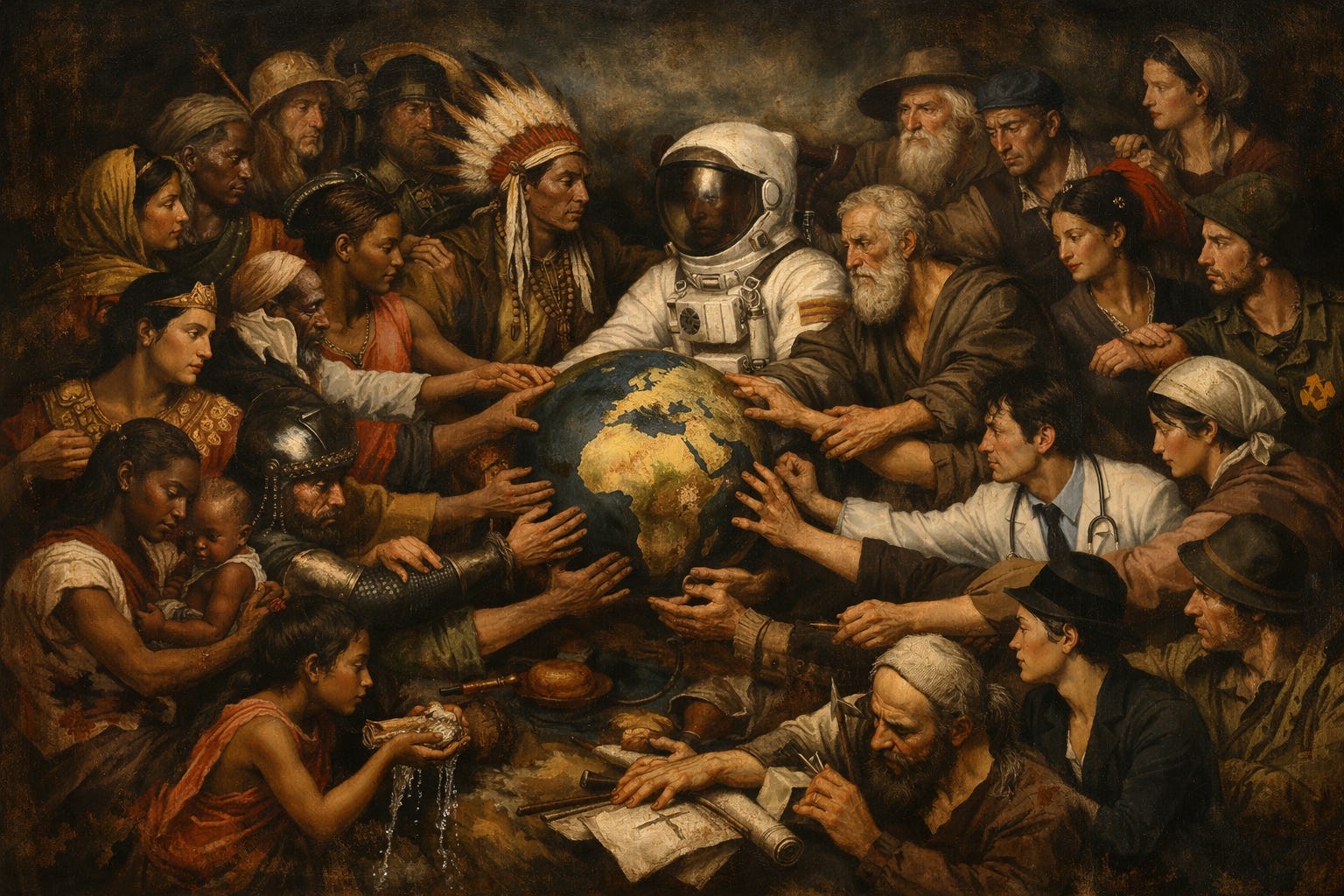
Our adaptation, what has made us the dominant species on the planet is what we can call “Civilization.” Civilization is what allows us to draw on the knowledge, skills, and resources of billions of people. We can draw upon the knowledge of the living and the dead, reaching back generations, and projecting what we know to generations we will never see. A web of mutual obligations, encompassing the globe brings all humanity, and all that humanity knows and has ever known to where you are, right now.
Yes, other animals shape their environments to their liking, but no termite is waiting for building materials from across the planet. Other creatures learn by imitation, but no other creature can reach back into the past of its species and consciously search for the wisdom of their ancestors.
As our interconnection grew, so did our power. It’s very much like the telephone. If there’s only one in the world, it’s pretty useless. But each new phone connected to the network increases its usefulness. And by the time you have a few million of them, it’s indispensable. Likewise, as humanity became more connected – more interdependent, the scope of what we could do grew geometrically. But while we grew ever more able in terms of what we COULD do, our consideration of what we SHOULD do lagged dangerously behind.
The fact of human existence is interdependency – the more complex and advanced the society, the more interdependent it is. Individuality, sectarianism, even nationalism are illusions. Humans simply cannot make it on their own – they weren’t designed to. When a society becomes advanced, trouble halfway around the world can severely affect life in that society by disrupting the delicate net of mutual obligations. Misery anywhere can cause misery everywhere.
But humans, despite their absolute dependence on each other, experience life as individuals. You see, smell, hear touch and taste through your own senses, and those senses are centered around a locus that feels very much like one’s own consciousness. This creates the illusion of independence, despite the fact that everything that a normal human does in the course of a day involves the participation of millions of people.
Gone are the days when a nation could piratically “colonize” distant lands, do as it likes, strip the land of resources, build vast wealth on the suffering of others and never worry that its selfishness would have consequences. Now, such behavior creates refugee crises, which flood other countries with unscheduled dependents, and fill the airwaves with cries for justice. The movement of trade is likely to be impaired, both by the war and the refugee crisis, and by political responses in the form of boycotts and sanctions. We are simply too interconnected now for the misery to stay localized.
Likewise, one hears people saying that they have “individual rights” to do anything they like, so long as the law doesn’t prohibit what they’re doing (or even if it does, if they’re confident they can get away with it.)
First of all, you don’t have “individual rights.” There are no such things. Rights without a society to protect and enforce them are meaningless. Without society, and a system of laws, there are no rights except the right of the strong to do what they will, and the weak to suffer what they must.
Secondly, your “rights” are not absolute within a society. We have to work together, and live in relatively congested spaces. If you tell me you have a right to pay your workers as little as you possibly can, and those workers have sick children because their parents couldn’t afford to feed them properly, or they grow up maladaptive, unproductive or even criminal because their parents were working so hard to pay the landlord – who was exercising their “right” to charge as much as the market will bear, that they couldn’t see to the proper rearing of those children then you, me, the parents, the children, and probably the taxpayers will bear the brunt of your selfish insistence on seeing your “rights” as distinct from the need to be responsible to society as a whole.
Remember that web of obligations that spans the globe, and reaches from our deepest past into our future? When you behave as if you can lie, cheat and harm others without consequence, you damage that net. Each deception and act of cruelty tears it a little – distrust makes it less effective in binding us all together.
And bind together we must. Our planet, and our species face challenges of Fermi Filter proportions. The climate is collapsing from excess heat. Instability, even great power belligerence is making an unwelcome comeback. It is true that trade partners seldom go to war – but there are exceptions in the record, and the presence of vast stockpiles of weapons of mass destruction in many hands should give us cause to dread a sudden spasm of irrationality or fear. The only solution to either of these problems – and many more of global scope is to realize that we are all profoundly interdependent, and to stop insisting on the provably false illusion that the great game of nations still can be played – that one country, or nation, or people can profit at the expense of others.
Likewise, we must overcome such ideas on the personal level. You cannot harm others to your own benefit without the harm spreading to infect society as a whole. You cannot be cruel just because you tell yourself the lie that “business is business” and expect the damage you do to be limited to the individuals you make miserable.
Where others live in hunger, or fear, no matter how far away, you are not safe. The reality of global interdependence, no matter how hard some bigots would wish it away, is here. No individual, or individual country now can act without affecting others in profound and complex ways. If we can realize this, and accept it, we may have a fighting chance at a future. If we don’t we will eventually either incinerate, irradiate or poison ourselves and fade into the great silence among the stars.
We don't hear from other civilizations because when they fly by, they lean over and lock the doors.
Standing by, Good Sir, for Part III... 😎✌️