

The Evil Circus
The Machine That Owns Your Mind, and How to Take Control Back

You don't know it, but you were born into the Evil Circus. So were your parents. So were your children.
So, what is the Evil Circus? It is a social dynamic that seeks to dominate everything you see and hear. It does not seek to control you directly, it tries to direct your every conscious and subconscious decision by substituting every bit of sensory data with manufactured illusions, tailored to create a mindset, and therefore, profoundly influence all of your assumptions, habits and actions. There is no need to control you directly if it can cause you to substitute all the evidence directly lived with the product of its ever-present machine of sensory immersion.
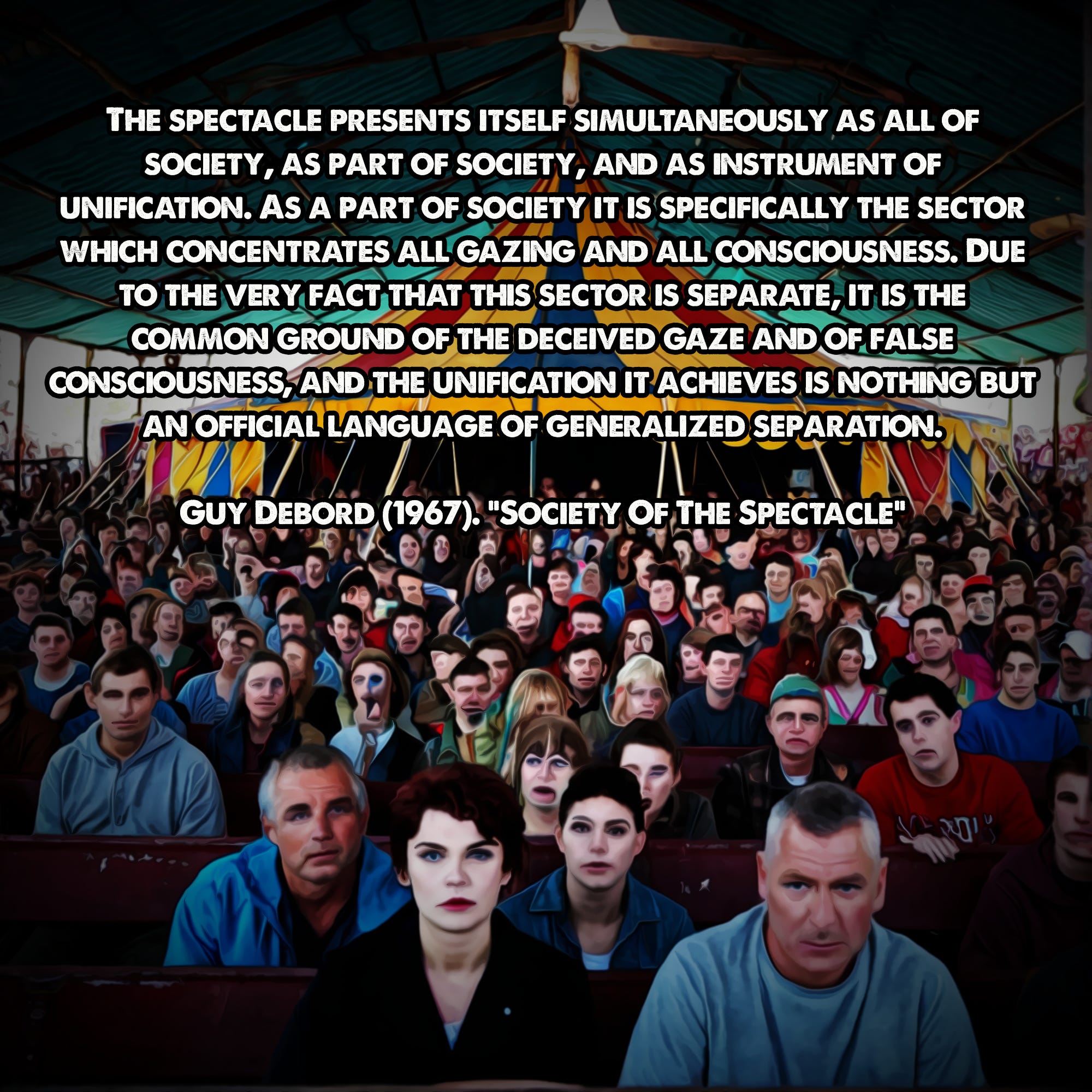
You know by now that there is really no practical way of escaping the show entirely. Not just commercials, everywhere and constant, or “news” programming, it is the stories themselves, in entertainment, in news, in every contact you have with media of any kind.
It is not limited to your viewing habits. Social media, by its nature and by design shows everyone you know doing the same kind of things. Consuming, participating in canned travel experiences and commercially approved entertainments, and smiling along with friends and family. Posts that suggest that all is not well get disfavored, both by the algorithm, and by the viewers. They provide the illusion of social connection while not building the personal bonds that might make manipulating you more difficult.
If you are talking to your friends about your life directly, asking them about products, politics, and “lifestyle choices,” you are less vulnerable to their programming. The commercial tells you that buying this or that will increase your social clout, make you happier. But your friend may not agree. And the Evil Circus does not welcome competition for the space in your mind that forms impressions and opinions.
This is not a new observation.
“In societies where modern conditions of production prevail, all of life presents itself as an immense accumulation of spectacles. Everything that was directly lived has moved away into a representation.”
- Guy Debord (1967). “Society Of The Spectacle”
This “accumulation of spectacles” is what I am calling the “Evil Circus.” Its operations are quite out in the open. In fact, it seeks, rather demands your attention during every waking hour. It is not limited to commercials, it permeates all forms of mass produced entertainment, but try to count the number of commercials, unsolicited phone calls, spam messages and emails, and other attempts to sell you something or influence you in one day. You will find that even getting an accurate count is difficult.
But these are only the most overt methods of dominating your attention and trying to influence you.
“News”
Regardless of the perceived political slant of any particular news provider, every one of them present themselves as arbiters of what is “really” going on. But the conditions of modern media – the reach of a particular provider and the strength of its influence are dependent on vast amounts of ready money. Network servers and television production are not cheap. Not at all.
Someone has to supply that money. And it is absurd to think that those who provide that money will allow those they feed to bite their hands. Not very hard, anyway.
Some money is supplied by rich people who wish to influence what the news, often described as the “first draft of history” records. But the vast majority of it is supplied by advertisers. And their influence is the primary shaper of what is and is not considered news.
A friend of mine, a journalist, once said that the only reason his stories saw print (it was a younger time, when ink on paper still mattered) was that they couldn't sell ads in that space.
Of course, I, and probably you, were raised to believe that the news should be reported and published “without fear or favor.” Is that really the case? Was it ever?
Ask Stephen Colbert. Or Dan Rather. I could make quite a list. And if these titans can be brought down by the corporate masters, what of the workaday journalist, underpaid, on deadline? What of their editors and publishers, who struggle to make news entertaining enough to keep you watching for long enough for them to push ads for cheap, watery beer, pointlessly enormous trucks and boner pills?
The vast majority of the information you receive is corporately curated by a few conglomerates, all owned by enormous corporations who do not scruple to tell you what they think is important. Which happens to be what it is to their advantage for you to hear and believe.
Everything I'll ever write about Epstein:
The real Epstein story isn't what he did, or who was involved, it is that he was able to do this among the highest circles of American wealth and power for years before he was publicly exposed.
According to court records, he was trafficking children as early as 2002. He was first prosecuted in 2006, slapped on the wrist after pleading guilty to two felony prostitution charges. The victims were not notified of the agreement and all grand jury subpoenas were voided. He served thirteen months, and was allowed to “work” six days a week in his Manhattan office during his “incarceration.” He celebrated his release with several prominent people, including Prince Andrew.
The records were sealed. Epstein was ordered to register and report as a sex offender. He never reported. There were no consequences.
I give you this because the real scandal here isn't Epstein himself. It isn't even the glittering gala of celebrities that were his “friends.” The scandal is that the media avoided this story until 2018. Yes, the records were sealed, but the supposed business of the Press is finding out what the government, and powerful people don't want us to know. There were multiple lawsuits from victims over the years that received scant coverage, or the victims were subjected to the “nuts and sluts” treatment, despite the youngest victim who sued being 13 at the time of the abuse.
Why does all this matter? Why did the supposed watchdogs of the media walk around or soft-soap this story for over a decade, when there was more than enough smoke around it to suggest a fire? You would think this story, full of scandal, celebrities, outrage and glitter would be catnip for the smut-obsessed media.
But, no. It was not just ignored, but actively covered up for over a decade. Why? The people who would have been implicated were powerful and connected, especially politicians, billionaires and corporate boards. Often the same boards that owned those media outlets. The victims, well, they were nobodies. Nuts and sluts.
Even when a story would be a big ratings hit, or when it should produce moral outrage, that's nowhere near as important as the interests of those who hold the purse strings. If they don't want you to know, you won't know. At least until it's convenient for them.
The examples are legion. The Catholic Church's sexual abuse scandals were covered up for decades before an independent newspaper broke the story. Of course, since independent news outlets barely exist anymore, we needn't worry about that happening again...
It would quickly become tedious to list all the examples of stories spiked because they do not serve the purposes of those who really control what you see and hear as “news,” not just because they might embarrass them, but because they don't fit the narrative they are trying to build. They would be a smudge on the screen, a discordant note in the soundtrack of the Evil Circus.
That's Entertainment
The attempt to influence you through entertainment isn't just limited to product placement. The themes of the shows and movies and music you consume are carefully selected by the corporate monopolies, fewer every day, that own the means of production. I say carefully selected, but they are not at all subtle.
The amount of “Cop-aganda” on my streaming suggestions, although I generally avoid it – hovers around 40 percent. Likewise, war movies in which brave Americans or close allies slaughter vaguely ethnic looking “terrorists.” In many of both sorts of movies, the hero (rarely female) “plays by their own rules,” ignoring the law and the rights of others, even torturing suspects or enemy combatants. What are the rules worth if you're the “good guys”1 battling Evil after all?
This is not an accident, of course. The message, “If the threat is great enough, we can ignore human rights, the law, and everything else and still be the good guys” is very useful to those who control the media and can easily convince most people that they are the good guys, and that any “threat,” manufactured or not, is nigh apocalyptic.
Likewise, the barrage of superhero movies, that teach you that the powerful can commit violence without consequence, again, as long as they're the good guys, and the threat is horrific in scope.
The American electorate, at least a majority of them, have been easy to convince that one threat after another justifies disregarding law, Justice and fairness in combating them. In my adult life, the Satanic Panic, crack babies, juvenile “superpredators,” “groomers,” and now immigrants (at least the non-white ones) are the horror du jour that the superpowered servants of the corporate states will save us from. If your rights get trampled, well, that was the sacrifice that must be made – correction: the sacrifice that you must make.
Note that this is no different whether the government is tending toward Fascism, or in the control of the status quo, pro-corporate, “Democratic” center right.2 They both create, and exploit moral panics at their convenience.
Your better life through consumption – and debt
This is aside from the barrage of advertising that you are subjected to constantly. And the message is usually the same: buy this, and you'll be more socially acceptable. You'll look prosperous. You'll be the envy of your friends. Your family will love and respect you for it if you'll buy this.
Your child will rejoice, and run into your arms if you buy this toy. Drink this beer, and you'll be surrounded by happy friends. Buy this car, and you'll be the envy of everyone you pass. Buy this pill, and you'll be a sexual dynamo. Or at least, you won't die. Buy this insurance, and you'll prove you love your family. Buy this other pill, and you won't be sad anymore.
And how do you do this? Well, use this credit card. Take out this loan. Buy this on credit.
Seeing the Fnords3
Really, all this can be communicated with a simple example, but fair warning, once you see it, you'll never be able to unsee it.
Ready?
Observe any form of public media, from the Internet, to a simple print magazine. Notice what the vast majority of the news articles have in common? They're designed to keep your attention by provoking low-grade anxiety and keep you watching. “Is there arsenic in your kid's school lunch? More after these messages.”
Then, the ads are designed to provide means of relieving anxiety. And the prescription, no matter what the anxiety? Buy this. Believe this.
The idea is to create an emotional need for release from anxiety, and then to provide the means to meet that need. And each time the need is met by buying something, the habit of doing so becomes stronger.
Every need, from relief from loneliness, to fear, to health is answered with the same solution. If you are fearful of the social changes that are coming too fast, and the danger the news tells you is going to overwhelm your community, buy a gun. Vote for this politician. If you are lonely, buy this and you will be admired by a gaggle of attractive new friends. Feeling powerless? Buy this powerful new truck. Worried about your economic status? Use this credit card. Worried about your health? Tell the doctor to give you this particular medicine. The ads always have an answer.
And since you're in perpetual debt from all the relief you've already consumed, you have to keep working for them. And worrying about what happens if they decide you're not productive enough.
“Not productive enough.” Think, if you dare, about what that means. It means that you work to create value, most of which doesn't go to you, it goes to those who own the output of your labor. They get the value of your effort, your creativity, your irreplaceable time, and you get more fear. Which means you need to buy more.
Best not to think about that. Become less productive, and you might not be able to afford your next dose of retail therapy.
None of this is a conspiracy in the formal sense. There are conspiracies against the peace and safety of society in the name of profit, but the overarching conditions and social dynamics are caused by the incentives inherent in the system. Playing by the rules as they're established, the consumerist, greed-driven, exploitative method is the most successful strategy.
And keep in mind, those who are winning the game don't want it to change, and those who are losing it are too powerless and frightened of falling off the edge to change it.
Media: Form and function
“The medium is the message.”
- Marshall McLuhan, “Understanding Media: The Extensions of Man” (1964).
The medium has a greater impact on human perception and behavior than the specific information it carries.
According to McLuhan, different media technologies, such as print, radio, television and the internet, have different effects on human consciousness and culture. Each medium creates a unique environment that shapes the way people think, feel and interact with one another.
As McLuhan argued, an underestimated factor in analysis of media is the form of the media itself.4 A printed article has certain limitations and advantages built into its nature. It is words on a page. Therefore, it's translation into meaning must be done by the reader, who must give it their attention to some degree. You must think about what you read for it to acquire meaning.
You can also easily share an article or a book, which facilitates accurate and relevant discussion of it.
Printed text on a page also has inherent disadvantages. Most people find reading tiring, not having developed the attentive stamina for it in their youth. It is also something that is difficult to do effectively while doing something else. If you can't split your attention into smaller and smaller portions, if you can't “multitask,” then you're not as productive.
And if you aren't productive, you aren't safe.
And that's a lie. You aren't safe even if you are productive, but let's not admit that quite yet.
Consider the modern history of media. The modern era begins just before the Industrial Revolution, the first time that media could be mass produced. The printing press made the experience of reading common, and the result was the Götterdämmerung of the current age. Luther and his detractors printed their pamphlets, Bibles became accessible, despite the murderous attempts of church and state to prevent it, and Europe tumbled – literally, out a window in Prague,5 into two of bloody wars.
People read. And they talked to each other about what they read. And sometimes, they got very, very angry. All the printing press smashing, book burning, reader persecution and author burning did nothing to change that.
The next great media revolution came with the widespread adoption of radio. Radio then required attention. The radio often occupied the same central, often altar-like position in the common family room as the viewing screen has in the current American home. Radio was different than print in that it allowed personality and charisma to help persuade the audience in a way that the printed word could not. It also allowed the rise of what we would now call “fandoms.” Individuals now became trusted celebrities with a personal following. Radio preachers such as Aimee Semple McPherson, Father Coughlin, and Herbert W. Armstrong developed far larger followings than would have been otherwise possible, and wielded considerable power and influence, reaching into politics as well as religion.
Franklin D. Roosevelt's “Fireside Chats,” which began in 1933 and continued into 1944 were widely credited with calming the United States during the Depression, and sustaining confidence during the darkest years of World War II. Their calculatedly informal and friendly tone were at least as useful as the often heavily spun information provided.
Of course, the most consequential movement to use the new media effectively was Fascism. The message of Fascism was broadcast directly into homes, and the scapegoating of various minorities was made effective and immediate. While Fascism might have still risen if radio hadn't existed, radio definitely was used by Fascist regimes to consolidate their power, and to immerse their audiences in Fascist propaganda. Especially once the regime had come to power.
Why was this so effective? Remember McLuhan's observation that the nature of the medium itself shapes its social impact? Radio is an immediate, one-way (at the time) form of communication directly to larger audiences than any media had ever enjoyed. You listened, along with thousands, or even millions of others. While anyone could write, not everyone could own a radio station. While not everyone could read with attention, anyone could listen.6
Next came television. The effect of the widespread adoption of television on American politics and the dissemination of information was even more far reaching than that of radio. In the 1960 election, the first televised debates between Nixon and Kennedy established Kennedy's charisma and ready for television appeal. Very few commentators talked about the facts or arguments. Most of the discussion revolved around how at ease Kennedy seemed, and how nervous and out of place Nixon's presentation was. Television made personality, specifically, the tailored-for-television personalities of candidates their most important asset.
Television, especially after the abolition of the Fairness Doctrine under the Reagan Administration began the balkanization of the media audience. It now became easy (it had always been possible) to immerse oneself in a single, carefully curated point of view. While partisan news outlets had always existed, Fox News, founded and directed by leading right-wing ideologues, raised this formula to near perfection. It was now possible to never hear a fairly presented point of view from the other side of the political spectrum. Where once, most people watched the same news shows that were limited in their partisanship by the Fairness Doctrine, there were now rabid partisan networks that you could watch for hours a day. The psychological and political effect of this was to increase polarization and hostility - remember, television media keeps people watching by continually stoking the anxieties of its viewers – and American politics saw the rise of the politics of outrage, more powerful than ever before.
If radio limited who had access to mass media, television increased that effect by an order of magnitude. Owning a television station is even more exclusive than owning a radio station, and in the current landscape, all the television networks are owned by corporate conglomerates, fewer and fewer of them by the year as they merge and consolidate. The most influential media is that which is almost entirely owned by Wall Street.
This led to the rise of “Infotainment,” in which ratings became far more important than a reputation for accuracy. Wall Street cares little about anything that doesn't appear on a quarterly earnings report, and, to them, a good news operation is one that makes as much money as possible, while spending as little resource as possible. Therefore, investigative journalism, especially that which might inconvenience or discomfort the owning corporation or its major sponsors is suppressed. Pieces that support the interests of the corporate ownership and their profit obsession are prioritized, and those who provide them find their careers progress as a result. Those who don't play along are marginalized, both professionally and personally.
"Après moi, le déluge" The Rise of the Internet
In October of 1969, a simple network link was established between UCLA and Stanford Research Institute. From this modest beginning, a network has been built that connects 5.65 billion of the Earth's 8.2 billion people. Almost 70% of the world's population have the ability to connect to each other instantly. It is a technological miracle without equal in the entire history of human accomplishment.
And it has completely transformed the nature of mass media. Now, everyone can broadcast, everyone can write for public consumption, and reach millions, maybe billions of people. There are no gatekeepers anymore.
Or are there?
Those of us who were involved in the early days of the Internet thought we were going to create a new Renaissance. We were certain that this radical expansion of what could be said, and by whom would spark new creativity. Universal access to all the world's information would allow genius to flourish. Bad ideas would be exposed to the best and brightest. We said, “information wants to be free.”
Predictably, that didn't last.
As access to the Internet passed over to private control, the pressure for constant, and ever growing profit took hold. Advertisements became ubiquitous, including ads for pornographic and scam sites that popped up during browsing. But technological fixes for most of these problems came eventually.
But there is a more serious threat to the Internet's potential. It does not lie in direct control, of the kind that corporations wield over the television and radio stations and newspapers they hold. It is the power of directing attention.
While the Internet doesn't “belong” to anyone, its immense size makes it difficult to use effectively without tools to sort and categorize the staggering, ever increasing amount of content. Back in the ancient days, we had actual, physical directories full of Usenet groups. The thought of searching 1.2 billion websites for a specific piece of information manually boggles the mind.
The answer was search engines. Search engines crawl the net, and then categorize websites, searching through them for certain key words. When a user enters a key word into the search bar, the search engine presents them with a list of sites that use that key word.
That list, of course, is ordered. Most users click on the first link, if it seems at all relevant. Very few go beyond the first ten results, and beyond that, few indeed.
And while the Internet doesn't really belong to anyone, the search engines do. And those who own and control what most people use as their gateway to the Internet use that control to their benefit and profit.
When you search on Google, and the vast majority of people do, the first thing you encounter is an AI guess at the answer to whatever you were looking for. Next come ads that are, more or less, related to the topic you're inquiring about. These ads have become less and less obvious as the years have gone on, until they are almost indistinguishable from resources that might answer your question.
Then, the sources. How are they ordered? It matters, since most people will click through to the first site they come to that may answer their question.
Formerly, in a more innocent time, sites were listed in the order they were most visited. This proved less profitable for advertisers, so it became possible, even necessary to have your website higher up the list. So you pay Google to move your site higher.
Google, via an algorithm, tracks your every click as far down your path as they can manage it. So, when you click a site, especially if you spend time there, and especially if you buy something there, the algorithm prioritizes similar sites in your next search result. And they sell that record to advertisers, who put more ads on Google, and pay to move their ads up the list. It's a very profitable cycle for all concerned.
Except for you, of course, who only wanted to know the name of Obama's dog for the rock opera you were writing, and will now be bombarded with ads for pet supplies and political campaigns every time you go online for the foreseeable future. And every time you answer your phone. And in your email. And just about everywhere else.
Remember that the way advertising works is by creating an emotional need, and then selling you something to meet that need. The Internet isn't only a selling machine, it's a machine that creates anxiety and need.
Social Media
The average user spends almost two and a half hours on social media every day. Many spend considerably more. Around 231 million Americans spend time on social media daily. That's more than those who regularly go to church once a week. By contrast, 163 million Americans claim to have read a book, any kind of book in the past year.
If you have over two hours every day with someone's attention, you have the chance to influence the way they see the world profoundly.
So what is all this influence being used to do? You don't pay for access to most social media, and as has been said, if you're not the customer, you're the product being sold.
Social media makes its money by selling your data. By giving it access to your interests, location, age, family details and hobbies, it is able to sell access to your feed to highly targeted advertisers, who seem to have uncanny knowledge of everything about you, your family, and your friends.
If you were a fairly early adopter, you can remember a time when your facebook feed was mostly populated by what your selected friends posted. It was how you stayed in touch with old friends, and distant families, and followed hobby groups. But this wasn't profitable enough for people who were already multibillionaires, so Facebook, which is owned by a corporation called Meta Platforms, which also owns Instagram, Messenger and WhatsApp, reduced the number of posts from your selected friends and interests, and started pushing targeted ads into your feed, along with just enough content to keep you scrolling, hoping to find what you came there for.
This reflects a process that was named “Enshittification” by Cory Doctorow in a 2022 blog post. It describes what has also been called “platform decay.” When a new platform or service emerges, it is extremely useful and friendly to its users. The company strives to grow quickly, and so it provides a good service, in a user-friendly fashion. All the while, it is gathering as much information about its customers as they will tolerate, often by concealed or intentionally obfuscated means.
Then, when the service has achieved enough market share that it has many users that would be inconvenienced by dropping it, it degrades services the platform provides to make it more useful to advertisers, and de-prioritizes its users. They've already got your data to sell. They don't really need you anymore except as eyeballs to push ads at.
In the final phase, users begin to abandon the platform or service. It becomes nearly unusable, and actively hostile to its user base, restricting their access or even banning them for no discernible reason, failing to properly police its participation allowing endless trolling, race-baiting and spam, and being completely unresponsive to support requests.
The platform's growth gradually ceases, then reverses. Maybe it dies, or maybe it shambles along like the once ubiquitous MySpace. Yes it's still there. Tom is wondering why he hasn't heard from you.
But it doesn't matter if it dies. The owners and early investors have made billions, and they already have your data, which is all they ever really wanted from you. There's a little hit of dopamine left on the nightstand, sucker. Let yourself out.
How does this interaction with social media shape your experience of the world? To recall McLuhan's dictum, “The medium is the message,” what is the message, intended or not, within the form of social media?
It is not an accident that the pictures of your granddaughter's graduation are wreathed by ads for incontinence supplies. The algorithm knows that if you are old enough to have a granddaughter that is graduating from college, you are probably old enough to have specific medical needs. And if you ever searched for “incontinence,” or “bedwetting,” well, the algorithm knows. And has told thousands, or hundreds of thousands of eager advertisers.
The proximity of the product to your smiling granddaughter is no accident. You didn't think it was possible to associate a dopamine hit with adult diapers? You underestimate the wily algorithm, and its masters.
When you look at something online, anywhere online, the algorithm notices, and pushes more of that – specifically ads that relate to that, at you at every opportunity. To keep your eyeballs on the site, in order to push more ads, the algorithm pushes more of what you're already looking at. It isn't going to push Fox News at you if you've been watching Rachel Maddow, it's going to push “Democracy Now.” If you've been on OAN's website for weeks, it's not going to shove MSNBC at you, you might turn away in disgust.
Over time, you see less and less of what you disagree with or disfavor, and more and more of what you agree with. The results of the creation of this iron tunnel of certitude are well known and studied.
“On January 6, 2021, a social media post by Donald Trump became a driver for the violent storming of the US Capitol. The attack fueled discussions about social media’s role in political polarization and extremism and raised questions about how platforms should be governed. Multiple social media platforms were used to mobilize activists for the Capitol attack.”7
“Social media plays a significant and increasingly documented role in the planning, execution, and glorification of mass shootings, with recent analyses highlighting its direct involvement in youth gun violence. A Chalkbeat and Axios analysis of Indianapolis cases since 2018 found that social media was involved in roughly one-third of youth gun homicides, often serving as a platform for escalating conflicts, setting up drug deals, or sharing threatening content.”8
“Mass shooters frequently use social media to plan and broadcast their attacks. The 2019 Christchurch shooter live-streamed his massacre on Facebook, while perpetrators of the 2018 Borderline Bar and Grill shooting and the 2016 Pulse nightclub attack posted online during their rampages to gauge public reaction. A 2025 case in Tacoma revealed a teen building an arsenal and glorifying past shooters like those from Columbine and Uvalde, with social media posts referencing these events and marking weapons with massacre dates.” 9
“Social media platforms have become hubs for glorifying mass shooters, with content such as videos and memes celebrating perpetrators circulating widely. A 2024 report found that minors were exposed to 127 videos glorifying mass casualty attackers on TikTok and 54 posts on X, often shared within closed communities like Discord.” 10
“Social media platforms, particularly Facebook, have been identified as significant tools in the incitement and facilitation of genocide, most notably in the 2017 Rohingya genocide in Myanmar. The United Nations reported that social media played a significant role in the violence, with Facebook serving as a primary instrument for spreading hate speech and dehumanizing rhetoric against the Rohingya Muslim minority.” 11
“The 2017 Rohingya genocide was characterized by a well-planned and coordinated campaign of violence, including mass killings, rape, and forced displacement, which the UN and U.S. State Department classified as genocide, crimes against humanity, and war crimes. Facebook was central to this campaign, with the military and extremist groups using the platform to disseminate anti-Rohingya propaganda, incite violence, and coordinate attacks, leading to the displacement of over 750,000 Rohingya to Bangladesh.” 12
“Despite Meta's (formerly Facebook) acknowledgment of its role in 2018 and subsequent claims of improved content moderation, evidence suggests these measures have been ineffective, with hate speech ads being allowed to publish even after promised reforms.” 13
And this, of course, is before we consider the online harassment, and the documented psychological effects.
“Research indicates a strong link between social media use and depression, particularly among adolescents and young adults. Multiple studies have found that heavy social media use is associated with increased symptoms of depression, anxiety, loneliness, and low self-esteem.
A landmark 2018 study published in the Journal of Social and Clinical Psychology established a causal link, showing that limiting social media use to 30 minutes per day significantly reduced feelings of depression and loneliness compared to unrestricted use.
This suggests that excessive use may trigger negative emotions through unfavorable social comparisons, exposure to idealized images of others' lives, and the fear of missing out (FOMO).” 14
Social media is bad for you. It's bad for us all.
But you won't drop it, will you?
AI
“What do such machines really do? They increase the number of things we can do without thinking. Things we do without thinking-there’s the real danger.”
― Frank Herbert
An AI program is a piece of property, not a person. It is designed to create an illusion of self-will and rationality, but in truth, it is actually a machine that predicts, and supplies what the most common next word found on the Internet happens to be. It is, actually, a machine that is designed to tell you, not what it “thinks,” it is designed to tell you what others think.
The people who are shilling for AI development, and presenting it as an existential threat are doing so in hopes that the government and venture capital will throw millions at them in order to control this dangerous new technology. If it's so dangerous, why should we let you make it at all? “Well, if we don't the evil Chinese will.” You'd think they'd come up with a new scare tactic. The “Yellow Peril” has been around for a very, very long time.
Why does anyone think that the billionaires who control these companies will engineer them to be self-aware, and to become exponentially more intelligent? There is no profit in creating self-conscious superbrains. Since when has the corporatocracy valued self-awareness and intellect beyond that which is necessary to perform the tasks they want done? Building the “singularity” wouldn't be cheap, and where's the profit?
AI is the tool of those who make and control it, and it will serve their purposes. And it does not serve their purposes to have it running amok, turning everything into paperclips or goo. It will, however, continue to put its six-fingered hands into your life – targeting ever more ads, taking your entry-level jobs, taking ever more jobs that are not entry-level.
AI is property, not personhood. And it will serve the purposes of those who own it.
And what is that purpose? According to Forbes Magazine, “...50 to 60 percent of jobs will be automated or transformed by AI by 2040. Plus, Goldman Sachs estimates AI could expose up to 300 million full-time jobs to automation, with a quarter to half of the workload in these jobs being replaced by AI.” 15
Make no mistake. Ignore the hype. The purpose of AI is not to advance human welfare, it is to replace human jobs with AI programs that are cheaper, never sleep, never complain, and never ask for a raise. They don't have to be as good at your job as you are, just good enough. And the already rich, already powerful are doing this for no other reason than to gain more money, and more power.
And AI gives those who maintain the illusions that concentrate your attention a cheap, easy way to produce low quality, plentiful distraction that can overwhelm the market for authentic, human based and produced art and information. It is a fire hose aimed at a Zen garden.
Commercial art is already being replaced by low quality AI “slop.” Graphic design and music are already feeling the effect.
But after all, it's always been so easy to make a career in the arts.
The Effect of AI on News
The use of artificial intelligence is fundamentally reshaping the news industry, shifting how news is discovered, produced, and consumed. As of September 2025, AI-driven search tools like ChatGPT and Google's AI Overviews are increasingly becoming the primary point of contact between audiences and news, replacing traditional clicks and direct website visits, which diminishes visibility for bylines and publishers reliant on traffic. This transformation is driven by AI's ability to synthesize information from authoritative sources, leading to a convergence of narratives across different content types and a heightened need for consistent, reliable, and well-structured communication from organizations.
AI is transforming news production by automating routine tasks such as transcription, summarization, and generating data-driven reports on sports, finance, and weather, freeing journalists to focus on more complex, investigative work. However, this efficiency comes with risks, including the potential for AI hallucinations, errors, and the erosion of journalistic autonomy, especially when AI systems are used without human oversight.
The business of journalism is being rationalized and optimized by AI, which aids in fact-checking, content curation, workflow management, and even determining optimal publication times to maximize engagement. This shift increases platform companies' control over the information ecosystem, creating dependencies and potential "rent" extraction that threaten publishers' autonomy and business models.
A significant concern is the rise of AI-generated misinformation, deepfakes, and doctored media, which can be used to spread disinformation, impersonate newsrooms, and threaten journalist safety, particularly women journalists. The lack of transparency in AI systems and the potential for biased algorithms further undermine public trust in news.
As of 2025, AI is no longer a future prospect but a present reality in newsrooms, with major organizations like Bloomberg, The Washington Post, and the Associated Press already using AI to generate thousands of stories annually, primarily for factual reporting. The effectiveness and ethical use of AI in journalism will depend on the decisions made by news organizations about its implementation.
The above section was written entirely by AI.
Could you tell? Could you detect the pro-AI slant? AI “frees journalists,” and “rationalizes and optimizes” news gathering. It aids in “fact checking.” It “increases platform companies' control over the information ecosystem.” It is a “reality,” not a choice. Note how the cautionary caveats are buried in the middle of the piece, and in less certain language. And in the end, responsibility for errors and ethical harm done is shifted to the humans: “The effectiveness and ethical use of AI in journalism will depend on the decisions made by news organizations about its implementation.”
“Hey Rube!” “It's a Clem!” Defending the Evil Circus
“But certainly for the present age, which prefers the sign to the thing signified, the copy to the original, representation to reality, the appearance to the essence... illusion only is sacred, truth profane. Nay, sacredness is held to be enhanced in proportion as truth decreases and illusion increases, so that the highest degree of illusion comes to be the highest degree of sacredness.”
- Feuerbach, Preface to the second edition of “The Essence of Christianity” (1841)
Illusionists prefer attentive audiences, but audience members who are skeptical, who pay too much attention are likely to see through the scam. The best audience members are those who want to be deceived, who come into the show wanting to believe.
And this system, this spectacle makes people desperate to be deceived.
Why so? Because for most of us, life is increasingly uncertain, both economically and personally. Families are shattered and uprooted by the economic need to pursue the shrinking number and stability of jobs that can actually support a decent human living, much less allow the constant demands of consumerism wherever they might be found. As people leave jobs, and uproot their lives repeatedly, friendships and social cohesion, along with people's long term investment in their community are far more tenuous.
The majority of people will choose to believe a lie that comforts them over a frightening truth.
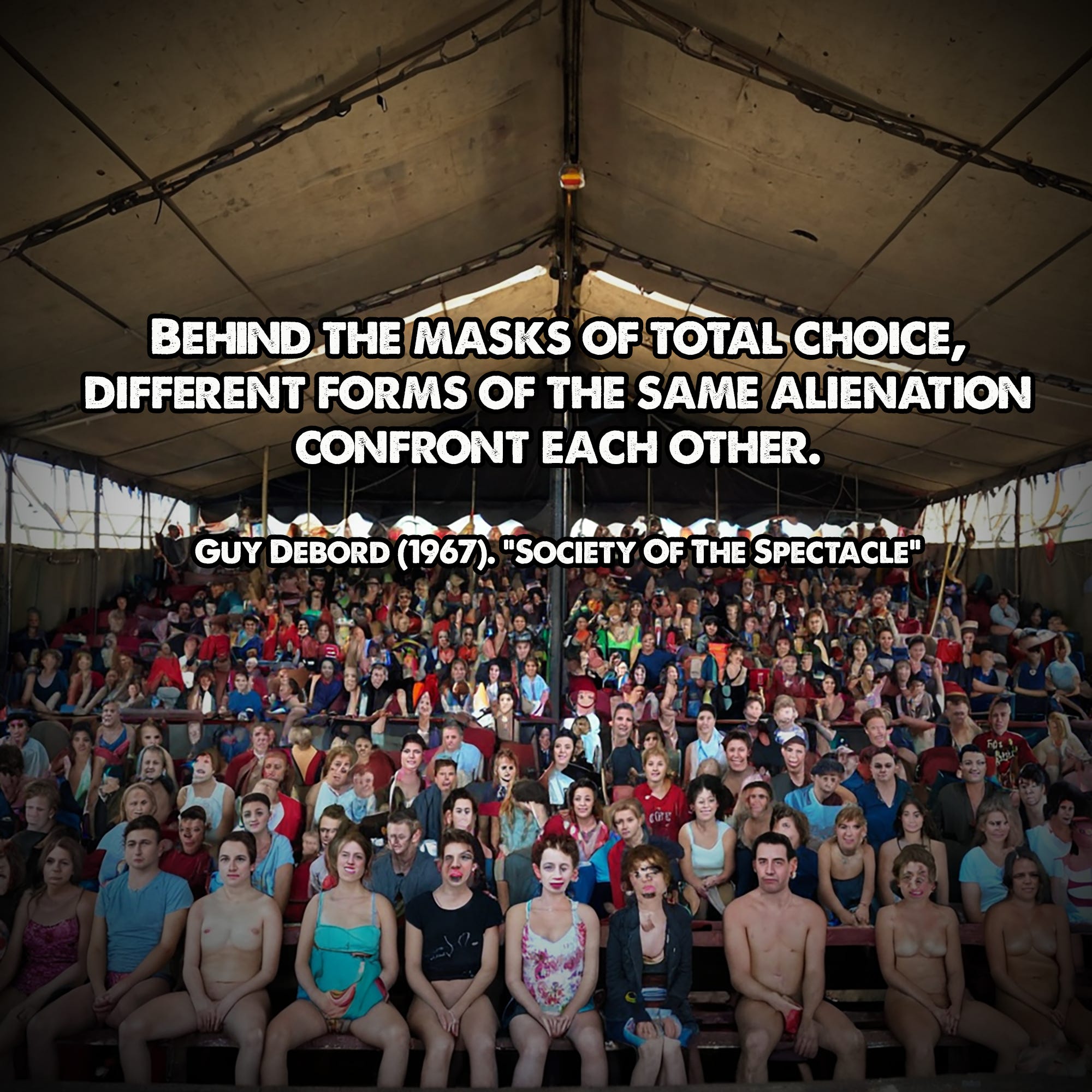
Atomization, the reduction of society to individuals, isolated, afraid, and receiving all their information about “real life” from the Spectacle is the ultimate goal. Such people need not be directly commanded, only the direction and object of their attention need to be manipulated to assure profit, production, and control.
But every now and then, someone sees through the illusion. But when you control what most people pay attention to, it's easy to marginalize the occasional maverick. “Shadow banning,” simply burying the dissenter's output deep in the search results, or disfavoring it in the algorithms is all that is necessary. No secret police, no knock in the night, no standard issue boot kicking in the door. Maybe a little psych drug intervention, if you don't want to be dragged in front of a judge and declared “non-compliant,” and locked away until you agree to play along.
Resisting the Evil Circus
The Evil Circus is organic, not collaborationist. It arises from the times, the economic conditions, the “school to work” emphasis and de-funding of public education and unprecedented technological acceleration in mass media and advertising. If you removed the most important, powerful and wealthiest people in corporate boardrooms and politics they would be replaced before sundown. There are conspiracies against the common good, against the rights and stability of the working class, but they would not be possible without the conditions that currently prevail.
Therefore, you will not, you cannot destroy the Evil Circus. It is the sword, the shield, and the grasping hand of the most powerful institutions and the richest people that the planet has ever seen. In fact, if they made you Emperor of All Creation, and you could abolish it, you'd be sweeping away free speech and expression on a historically unprecedented scale. No one does, or should have that kind of power.
But while the Evil Circus is organic, and a result of our current society's conditions, so are sewage and toxic waste. And as with sewage and toxic waste, the first priority is limiting your exposure.
“Attentive stamina,” the ability to concentrate on something for an extended period is the most potent ability that allows resistance to the Evil Circus. Of course, this is the capacity most eroded by exposure to it.
“The internet significantly impacts attention spans across different age groups, contributing to a measurable decline in sustained focus. Research indicates that the average human attention span has decreased from 12 seconds in 2000 to 8.25 seconds in recent years, which is less than the 9-second attention span of a goldfish.” 16
The Evil Circus is a machine that directs attention away from life as it actually is, and toward a construct. It substitutes itself for lived experience. You can't destroy it, you can't even convince most people that it is a construct. But you can do the single most powerful thing.
You can look away.
Those who maintain the Spectacle are very good at their work. The best, and the most well-compensated that the world can provide. You will not outsmart them, or see through them if you give them your attention for hours every day. It is hubris to think it doesn't affect you. It is so pervasive, that you can't reasonably expect to totally isolate yourself from it.
First, you must build the self-discipline to refocus your attention. This “attentive stamina” is like all other kinds of endurance – it is built by repetition, and doing what, perhaps at first, you might find uncomfortable.
There are many ways to go about this. Meditation, learning a new language or musical instrument, reading books you might find challenging, anything that requires you to concentrate your attention over a long time, and in a consistent way. You'll probably notice that all these activities are ones that people say they're going to get around to some day, but never seem to do so. There's never the time, or the energy.
Not when you're spending hours a day in the thrall of the Evil Circus.
Secondly, take an honest look at what you buy. Don't do it on a screen, write it down. How much of what you buy really improves your life, and how much is bought in reaction to feeling lonely or afraid? How much of it is a matter of trying to impress someone, especially yourself, with your status?
Buying something you wanted does make you feel better. You've been trained since you were a child to respond to getting that treasured thing with the release of dopamine and other psychoactive hormones that make you feel a short burst of pleasure, peace and satisfaction.
It doesn't last, of course. And that's convenient for the people who want to keep you on the consumption/debt treadmill for the rest of your life. How much stuff do you have that you haven't touched since the first month after you bought it? How much of that are you still paying for?
Seems simple? I dare you to try it. You will find more resistance than you expect, from yourself, and from others. There will be reasons that you just have to get online. There's a birthday coming up, and you have to shop for something. You have to look into the news story that just broke. All your friends are talking about a series that's streaming on Netflix...
And now you don't have time to do any of those other things you've planned – the reading, the learning, the honest look at your spending habits.
The Evil Circus doesn't like to be resisted. It will find ways to punish you for it. The Evil Circus isn't conscious, of course, but it is so pervasive that resisting it feels impossible.
But let's consider for a moment what will happen if you do manage to claw some of your life back. Let's say you decide to read Proust's “In Search of Lost Time” - a thematically appropriate choice. Further, you've decided that you're not going to get online except between 9-10pm. That will put you under the average, and you needn't fear FOMO so totally. You limit your time in front of any other screen to an hour a day. And finally, you're going to audit everything you bought over the last 90 days, and not spend on anything other than base necessities, groceries, utilities, mortgage/rent, insurance, debt service, and whatever gas and repair for your vehicle for the next month.
About a month later, here's what you will have done:
You will have read a fairly dense novel of about 1.3 million words, probably the longest novel in the Western Canon.
You will have been online for about 30 hours, and about the same amount of time watching television.
You will have more money in your pocket. Probably quite a bit more. And you will have thought seriously about every purchase you made.
None of these tasks are as difficult as climbing Mount Everest, running a marathon, or going to the gym every day, or giving up coffee. They are all well within your grasp. But you will find them very difficult.
Why? Because they all fly in the face of the conditioning imposed on you for your entire life by the Evil Circus. They all require you to actively focus on something other than the Spectacle that it presents as “real life.”
Here's how you will change:
Getting through Proust's mega-novel will have built attentive stamina. After having done that, you will know that you can focus for an extended period on something you found difficult, at least at first.
You will have begun to build the habit of mastering your own time. You will have begun to think seriously about how you spend your time – your most valuable and irreplaceable resource, and how you focus your attention, your most important ability.
And you will have learned a bit about life, art, and a certain, very interesting period in history. Proust is difficult, but very insightful about things like purpose, and purposelessness. And you will have the quiet satisfaction of having done something that the vast majority of people will never, ever do. Try to keep the brag at a minimum.
You will have learned that there are other ways to make yourself feel better than buying something.
You will have become aware that there is nothing on television or online that you can't live without, and your anxiety level will drop markedly. Not being exposed to constant demands to buy, news reports that try to keep you constantly worried, and propaganda about what you should believe, and how you should live will allow your autonomy to begin to grow.
When encountering media of any kind, you should develop the habit of asking yourself these questions:
”What is this trying to make me feel, believe or do?”
”Who does making me feel, believe, or do this benefit?”
This is resistance.
There are other ways to go about learning to take control of your attention, and your spending habits. But the important thing is to learn to be conscious about how you're living your life, and the decisions you make without allowing the Evil Circus unlimited access to your thoughts.
If you have read me for awhile, you'll probably guess where this is going.
Own your head. Or someone else will.
Footnotes
1Of course, following the rules and acting fairly are what make you the “good guys,” but that never seems to come up.
2 I will maintain that there is no significant “left” in U.S. politics, and there hasn't been since FDR. Fight me.
3Don't see the Fnord. If you don't see the Fnord, it can't eat you. Don't see the Fnord.
4Music deserves an essay of its own. The phenomenon of “popular” music, and its corporate commodification and commercialization is a story that I must, at least for now, leave to a separate analysis.
5More than once. There was a bit of a vogue for throwing politicians out of windows in Bohemia, in 1419, 1483 and 1618. In an early example of media spin, on the third occasion, the yeeted politicians, all Catholics, survived. The Catholic pamphlets claimed they were lowered gently to the ground by the Virgin Mary. The Protestant pamphlets claimed they landed on a dung heap. I suspect, as usual, the truth lies somewhere in between. It seems probable to me that the Virgin Mary gently guided their fall, so that they landed in the dung heap. One of the survivors was named “Baron of Highfall” by his grateful sovereign, perhaps because “Baron PileofShit” was already taken.
6The rise of right-wing talk radio, and the saga of Rush Limbaugh, and how he became the most influential “conservative” voice in American politics is instructive. There is not room for a full analysis here, and frankly, the thought of spending hours researching and writing about this Dollar Store Mussolini turns my stomach, but it is a significant example of how mass media finds its most susceptible audience, persuades and organizes.
7- “Mobilising the Mob: The Multifaceted Role of Social Media in the January 6th US Capitol Attack,” Javnost - The Public Journal of the European Institute for Communication and Culture, Volume 32, 2025
8“How social media fuels youth gun violence in Indianapolis,” Chalkbeat Indiana, September 8, 2025
9“How Mass Public Shooters Use Social Media: Exploring Themes and Future Directions,” Sage Journals, February 26, 2023
10“Minors exposed to mass shooter glorification across mainstream social media platforms,” Institute for Strategic Dialogue, January 24, 2024
11“Facebook, Telegram, and the Ongoing Struggle Against Online Hate Speech,” Carnigie Endowment for International Peace, September 7, 2023
12“A Genocide Incited by Social Media: Are We Blaming the Tool for Our Crime?” Harvard Undergraduate Law Review, Date not provided.
13“Genocide by social media posts: Will Facebook be held accountable?” MinnPost, January 3, 2022
14“How Does Social Media Play a Role in Depression?” VeryWellMind, July 9, 2025
15“These Jobs Will Fall First as AI Takes Over the Marketplace,” Forbes.com, April 25, 2025
16“Average Human Attention Span Statistics & Facts [2024],” Samba Recovery, March 4, 2025
Damn, amigo. You have been busy! My attention span has improved already😜.
Seriously, great writing as usual.
Thank you.
I wish we could have a direct conversation some day. I now have three full pages of notes, some are questions others are my personal experiences of the information you are sharing. I’ll by quoting excerpts of this essay for months I on Facebook with proper attribution. Unfortunately I don’t know many people that would read it in its entirety, but I’m going to try to print hard copies to give to close friends to read at their pleasure, but only if you have no objections. A work like this could very well be your legacy, and it would be a great one.